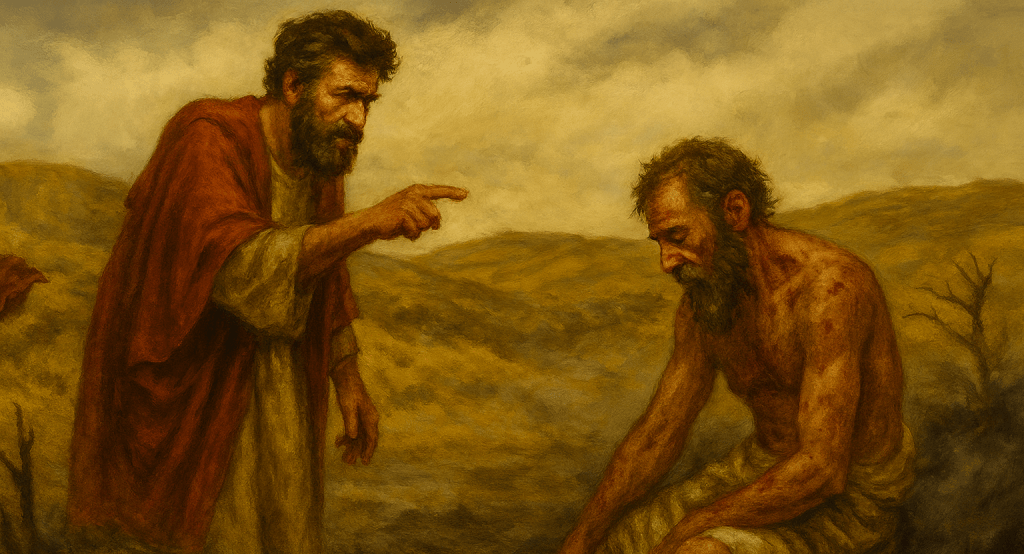
In our Job study, let’s pause with his friend Bildad. Are you like him? By the way, I think if he was female he would take the ultimate mean girl trophy. Bildad shows up as friend who clings to tradition like it’s a life raft, tossing theology around like bricks instead of balm. He leaned hard on ancestral wisdom and the “way things have always been.” Both Bildad and Eliphaz argue that Job must have sinned, but they come at it from different angles—Eliphaz is more philosophical, Bildad more blunt and traditional. And if I’m being honest, I’m a blunt Bildad: if compassion were a feather, I’d still hand you a brick.
Bildad’s speeches are short, sharp, and often brutal—almost like a hammer striking down Job’s hope. He is the friend who offers cold comfort, the one who believes suffering must always equal punishment, and he delivers his words without compassion. This is the friend who says things like:
• “Well, maybe God’s teaching you a lesson.”
• “You must have done something wrong for this to happen.”
• “If you’d just prayed harder, this wouldn’t be happening.”
Bildad definitely wins the harshness award, especially when he declares: “When your children sinned against him, he gave them over to the penalty of their sin.” (Job 8:4). That’s harsh in any contest. Ok, maybe I’m not Bildad after all. But he does give us room to look at our own statements when we’re walking with someone through grief, chaos, or a downright bad season.
In his first speech, found in Job 8, Bildad insists that Job’s suffering must be the result of sin. Here we go again. He appeals to the wisdom of the past, urging Job to “ask the former generation and find out what their fathers learned.” Bildad even suggests that Job’s children got what they deserved, a statement that cuts deeply into Job’s grief. Bildad doesn’t leave any room for other reasons behind suffering. For him, pain is always punishment, plain and simple. His theology is rigid: God is just, so if you are suffering, you must have sinned. There’s no mystery, no compassion, no possibility that hardship could serve a deeper purpose. Yet when we look at the wider story of Scripture, we see something different. Paul reminds us in Romans 5:3–4 that “we also glory in our sufferings, because we know that suffering produces perseverance; perseverance, character; and character, hope.” James echoes this in James 1:2–4, urging believers to “consider it pure joy… whenever you face trials of many kinds, because you know that the testing of your faith produces perseverance.”
Bildad’s formula equates pain with guilt, but the New Testament reframes suffering as a place where God can grow endurance, shape character, and birth hope. His speeches show us the danger of reducing suffering to sin, while Romans and James remind us that trials can be the soil where perseverance and faith take root.
By the time Bildad speaks for the last time in Job 25, his words are just downright the opposite of what we know to be true. He states man is nothing more than a maggot or a worm (Job 25:6). Imagine that? We were created in the image of God (Genesis 1:27), and Bildad has the nerve to say we are maggots or a worm. It is the shortest speech of all, but perhaps the most crushing. Bildad strips away Job’s dignity, reducing him to nothingness. His theology leaves no room for grace, only humiliation.
What Bildad teaches us is sobering. Rigid tradition can wound, especially when it is applied without compassion. Truth without love becomes cruelty. His speeches force us to ask—am I handing out cold clichés, or offering truth that’s actually wrapped in love?
So what did we learn from Bildad? Phew… what not to do!
It’s easy to spot Bildad in modern life. He’s that snarky sister in Christ who throws her wisdom at you like it’s scripture. You know the type: “Thou shalt not eat another piece of pie—your hips are already too big!” Or the one who asks, “Are you really spending quality time with your children?” right after you’ve confessed to a friend how overwhelmed you feel. Bildad shows up in those moments when someone’s chaos gets met with cold comfort and a side of judgment.
The problem isn’t that wisdom or truth are bad—it’s that they’re hurled like grenades instead of handed over like grace. Bildad reminds us that when we speak into someone’s suffering, we need to check whether our words are rooted in compassion or just tradition dressed up as truth.
Helping you find peace in the garden again— where we are reminded that worms don’t get the last word—God’s image does.
Pause and reflect on whether your truth-telling carries the weight of love—or just tradition.
- When someone around you is suffering, do your words bring comfort—or do they land like bricks?
- How often do you cling to tradition or “the way things have always been” instead of pausing to listen with compassion?
- Have you ever spoken to yourself with Bildad’s harshness—assuming your pain must be punishment?
- What would it look like to rewrite the way you speak to yourself, offering grace instead of judgment?
 Faith Over Chaos
Leave a comment